I Just Built a Zero-Employee Company — Some Thoughts
AI & Technology
I built a zero-employee company last month — as a challenge, as part of my AI journey, and to understand first-hand how AI changes the job of a SaaS and data CEO. Here is what I learned.
[](https://www.businessratechecker.com/?utm_source=mirror-mountain&utm_medium=blog&utm_campaign=zero-employee-company&utm_content=hero-image)
I built a zero-employee company last month. I did it as a challenge to myself, I did it as part of my AI journey and I did it to better understand how AI impacts my area of expertise as a CEO of SaaS and data businesses.
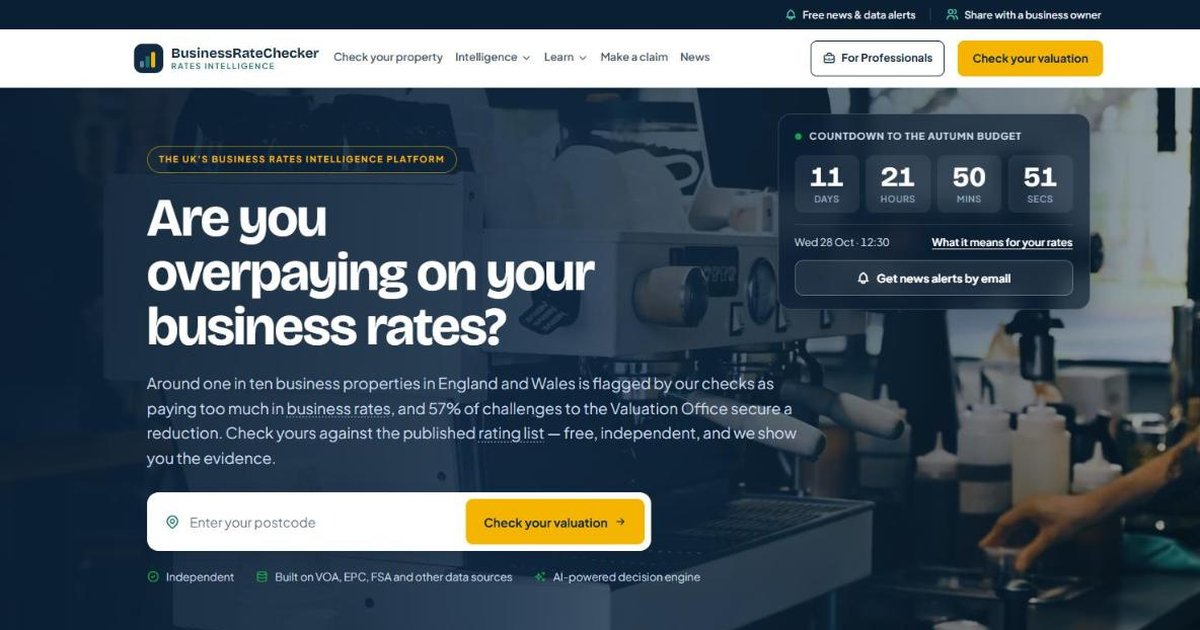
The business is relatively simple drawing data from multiple sources, enriching the output with analysis, making it easy to access and delivering a clear value proposition around saving money. Its goal is to save small businesses in the UK up to £500 million a year in overpaid business rate tax. I found a hyper niche area that is currently poorly served by technology. You can see the fruits of my work at www.businessratechecker.com. Feedback welcome!
Here are some brief learnings:
How did you do it?
I used a standard AI account to help me research a market, identify and then create a solution. While I have run SaaS companies for more than 20 years, I have never been able to write a line of code but I do know what questions to ask, I do know how tech infrastructure is architected, I do know how databases work and I do know what different technologies are and are not capable of. Without that background it would have taken me longer to get there but all the technology is there to make it happen.
Is it really a zero-employee company?
Not entirely. It still needs me to guide it, make certain decisions, set up new tasks and goals as well as challenge output. The AI is acting not so much as a CEO, COO, CMO, CRO or CFO but as a manager/team-lead level employee of these functions managing a raft of lower level agents/workers to perform various engineering, product, design, marketing, finance, legal, sales and other functions.
What do you mean acting at a manager level and not C-suite level?
The AI is not good enough yet to act as a C-suite professional (job safe for another few months) and by that I mean to act purely autonomously with a high level goal. It works well when given specific tasks but I would not trust it to exercise broader strategic judgement. It can still create thousands of lines of code at the touch of a button, deliver incredible analysis, whip up highly professional marketing plans and assets, conduct scale-able outreach to customers, draw up drafts of contracts and so on. All these tasks need to be reviewed, iterated and common-sense checked still.
However, the progress I have seen in the models since the beginning of this year has been astounding. The capability of the AI models has moved on from effectively Intern level to manager or team lead level capabilities. I have no doubt it will continue to move up to VP and eventually C-Suite level but it is not there yet.
How much time and capital does it require to set up and run?
Overall it cost about £150 ($200) in AI and other software monthly subscriptions and a fair amount of my time getting up to speed. I probably now spend about 30-60 minutes a day looking at data, course correcting any issues and discussing product improvements with the AI.
Are you making money from this business?
I celebrated my first few customers this week, which was supremely exciting, and traffic to the site is rising 30% week on week. It is not yet profitable (almost!) but with a monthly cost run rate of £150 the threshold for profitability is not high. It won’t become a multi-million-pound-industry-changing business but it does not need to be…with the cost of entry to build new businesses now so low, it is part of the Cambrian explosion of new ideas that is currently filling every corner of the business world. As a friend of mine put it to me the other day, we are in the age of the micro-business.
What did you learn from this experience with relation to more established and complex SaaS and data businesses?
I have worked with lots of SaaS and data companies in recent months and years seeking to remodel their businesses in the AI era. All are focusing on the business model, the proposition, pricing, changing customer habits, organisational and skillset impacts, how to seize more of the upstream value depending on where you are in the stack and simply how to remain relevant as the world changes around them at a frightening speed. All of this is good and necessary thinking and being forced to identify where you really sit in the value creation chain is incredibly important. I love the creative destruction and constant change that is such an important part of modern business and much has been written about all these topics.
One of the best analyses of the impact of AI on SaaS businesses that is worth watching is this interview with Microsoft CEO Satya Nadella, conducted over a year ago. And if you are still not convinced that AI will have a major impact on your software business, whatever it may be, then have a read of the news earlier this month that someone used AI to reverse engineer much of Adobe's Creative Cloud suite and published it openly. If that does not scare you as a leader of software technology - IP issues aside - then nothing will.
The most important thing I did learn from this project was that if you do not get your hands dirty with this technology yourself and use it to surface and build ideas you will never fully understand what it does and does not do, how it is evolving and how it can impact your business. What it can do today, is not what it could do yesterday and not what it will be able to do tomorrow and if you are not knee-deep using it you will not understand this.
My project folder has about 20 ideas running in it, of which 15 are really bad ideas or dead ends. But all those dead ends led to new ideas and new concepts and new ways of working – some are waiting for the technology to enable them - and that is the Darwinian process we all need to put ourselves through to keep up with the hyper change we are all experiencing today.